
For most of the last decade, ALS therapeutics has been a story of mutation-specific drugs chasing tiny patient populations.
Tofersen (Qalsody) targets SOD1 mutations, found in roughly 2% of ALS cases.
The other roughly 98% of patients have watched the field develop drugs they aren’t eligible for.
The reason is that the actual driver of most ALS, TDP-43 protein dysfunction, has been one of the hardest neurodegeneration targets to drug.
TDP-43 is intracellular, it forms aggregates inside motor neurons, and conventional antibody therapies have no good way to reach it. The protein is present as a pathological hallmark in approximately 97% of ALS patients.
For years, that 97% has been the biggest unmet need in neurology that nobody could solve.
Two announcements this week, from two completely different companies using two completely different modalities, suggest that’s starting to change.
AcuraStem, the Pasadena ASO company, received a $7.5 million CIRM grant to push AS-241 through IND-enabling activities for ALS and frontotemporal dementia. AS-241 is an antisense oligonucleotide that targets cryptic splicing of the UNC13A gene, a synaptic protein whose mis-splicing is one of the downstream consequences of TDP-43 dysfunction.
By correcting the aberrant splicing, AS-241 aims to restore synaptic function as a disease-modifying approach. The pitch: instead of trying to fix TDP-43 itself, fix the most damaging thing it’s breaking.
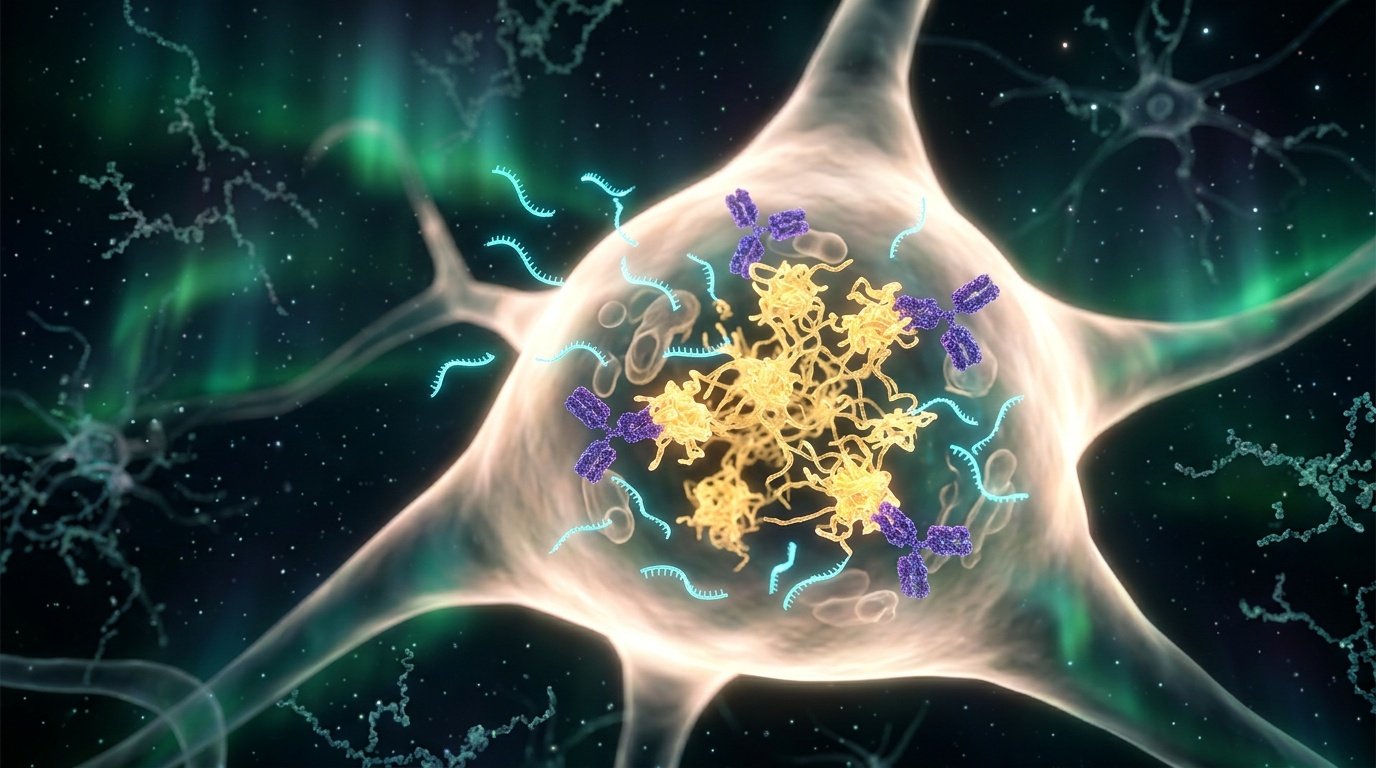
Meanwhile, VectorY Therapeutics in Amsterdam picked up MHRA and EMA clearances to expand the PIONEER-ALS trial of VTx-002 into Belgium and the Netherlands. VTx-002 is a vectorized antibody, an AAV-delivered antibody gene therapy that targets the intracellular TDP-43 aggregates directly.
First patient was already dosed in February at Mass General Brigham. FDA Fast Track was granted in January.
The Biotech Voyager
Early-stage biotech signals, personalized.
The signals that matter to you, contextualized and written directly to you, so you cut through the noise and immediately understand why it matters.
Read those two together.
AcuraStem is going downstream, repairing the splicing damage TDP-43 dysfunction causes in surviving motor neurons.
VectorY is going upstream, attacking the misfolded TDP-43 aggregates themselves with a CNS-resident antibody factory.
Same disease, same protein at the center, completely different therapeutic logic.
That’s what a real modality toolbox looks like.
The funding stories also tell you something.
AcuraStem already licensed its PIKFYVE-targeting program AS-202 to Takeda, which is a strong validation signal for a small private company, and its iNeuroRx patient-derived neuron platform has been quietly producing ASO candidates that pharma is willing to pay for.
VectorY raised €129 million Series A in November 2023, co-led by EQT Life Sciences and Forbion Growth Opportunities, with Insight Partners, LSP Dementia Fund, and MRL Ventures Fund participating.
Both companies have institutional capital that knows how long ALS development takes.
The pipeline beyond ALS is where it gets more interesting.
Both companies are extending into adjacent neurodegenerative diseases.
AcuraStem is positioning AS-241 for FTD as well, where TDP-43 pathology is also a major driver. VectorY has Huntington’s disease in its pipeline, applying the same vectorized antibody approach to a different misfolded protein.
If either modality validates in ALS, the read-through to FTD, Alzheimer’s tauopathies, and Huntington’s gets very real.
None of this is a clinical win yet.
AS-241 hasn’t dosed a patient. VTx-002 has dosed exactly one. The Phase 1/2 readouts from PIONEER-ALS will take years.
But for the first time in a long time, the 97% of ALS patients without a SOD1 mutation have multiple credible mechanism-targeted shots on goal. ASO downstream.
Vectorized antibody upstream. Possibly more on the way.
The Biotech Voyager Podcast
Deep dives on the signals shaping early-stage biotech.