Three months ago, EpiBiologics closed a $107 million Series B co-led by Johnson & Johnson Innovation and Google Ventures.
The money was earmarked for one thing: getting EPI-326 into humans.
They just held up their end of the bargain.
The San Mateo company dosed the first patient in a global Phase 1 trial of EPI-326, a bispecific antibody built on its EpiTAC platform — we’re going to dig into the significance of this approach below.
Initial indications are non-small cell lung cancer and head and neck squamous cell carcinoma. Colorectal cancer may follow. They’re running it both as monotherapy and in combinations.
If you haven’t been paying attention to extracellular degradation, here’s the short version: PROTACs and molecular glues, the “targeted protein degrader” (TPD) field everyone has been writing about for five years, exclusively operate inside the cell. They essentially hijack the proteasome and force a protein of interest to be degraded.
Since the proteasome is INSIDE the cells, this approach is limited to targeting intracellular proteins.
Here’s the issue: that’s maybe 60% of the proteome. The other 40%, the cell-surface receptors and secreted factors that drive a huge amount of disease biology, are out of reach.
Wwell EpiBiologics approach (EpiTAC) goes after that 40%.
EpiBiologics funding trajectory
Series A
Mubadala, Polaris · 2023
Series B
JJDC, GV · Jan 2026
$180M total raised · First patient dosed April 2026
How?
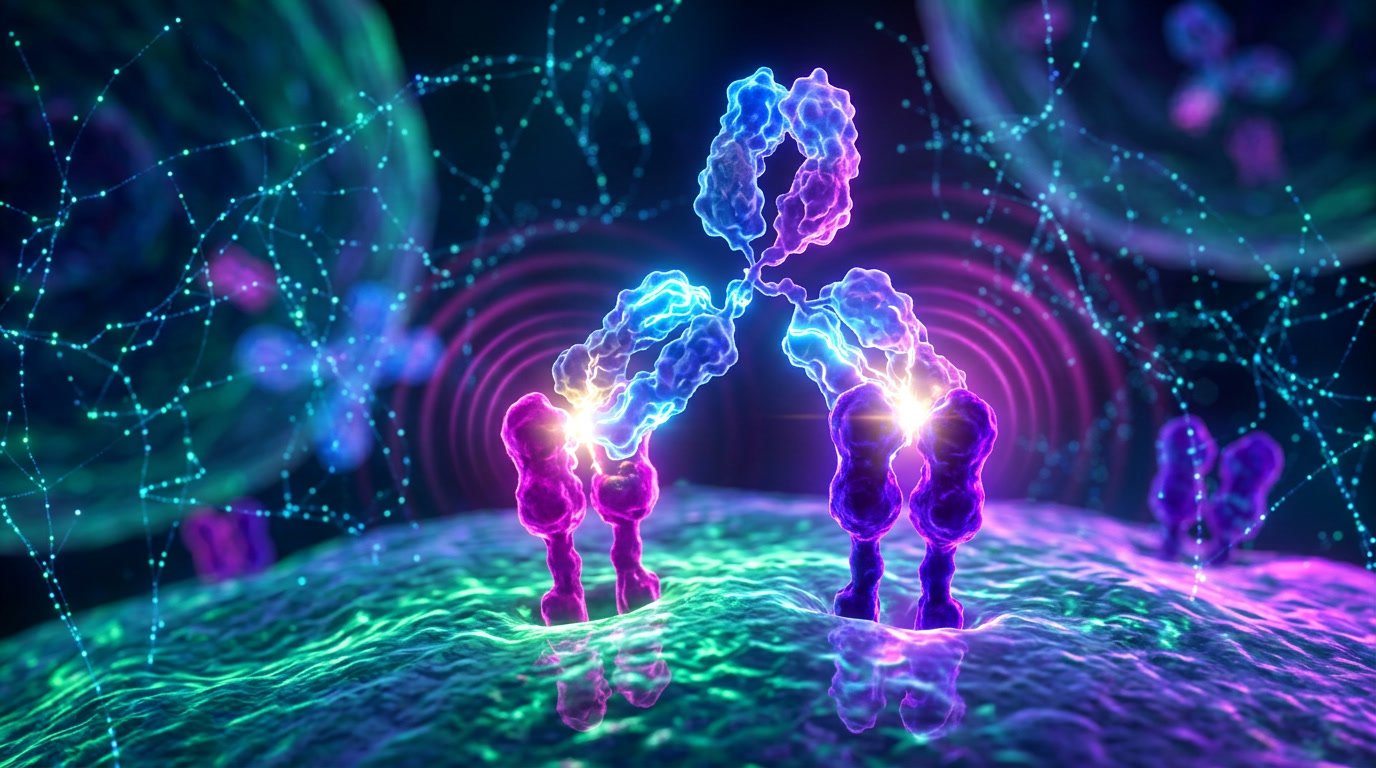
EPI-326 is a bispecific antibody.
One arm binds EGFR.
The other binds an internalizing membrane receptor that drags the whole complex into the lysosome for destruction.
So instead of inhibiting EGFR, it degrades it entirely.
Why that’s interesting: osimertinib and the rest of the EGFR TKI class work beautifully until tumors develop resistance mutations at the binding site.
When that happens, patients relapse.
EPI-326 degrades both wild-type and mutant EGFR. If the binding pocket changes, the degrader doesn’t care. It’s still taking the protein to the lysosome.
That’s the bet J&J and GV wrote $107M against in January.
EpiBiologics isn’t alone in trying to solve extracellular degradation. Draupnir Bio published SORTAC data in Cell Chemical Biology last month using sortilin-mediated lysosomal trafficking with small molecules. The broader degrader field has been on a tear. But EpiBiologics is the one now running a Phase 1.
They’ve built an EpiAtlas of over 270 degrader receptors across three categories: AbTACs, KineTACs, and TrainTACs. The platform pairs disease targets with whichever receptor gives you tissue selectivity. EGFR is the first program. A c-Met EpiTAC is behind it. Autoimmunity programs targeting regulatory T cells are moving through preclinical.
This is a platform company with a real Phase 1 now. For the protein degradation thesis, that matters. Intracellular degraders had to prove clinical viability first. Extracellular degradation has been a PowerPoint story for a decade.
As of last week, it’s a clinical story.
The Biotech Voyager
Early-stage biotech signals, personalized.
The signals that matter to you, contextualized and written directly to you, so you cut through the noise and immediately understand why it matters.