
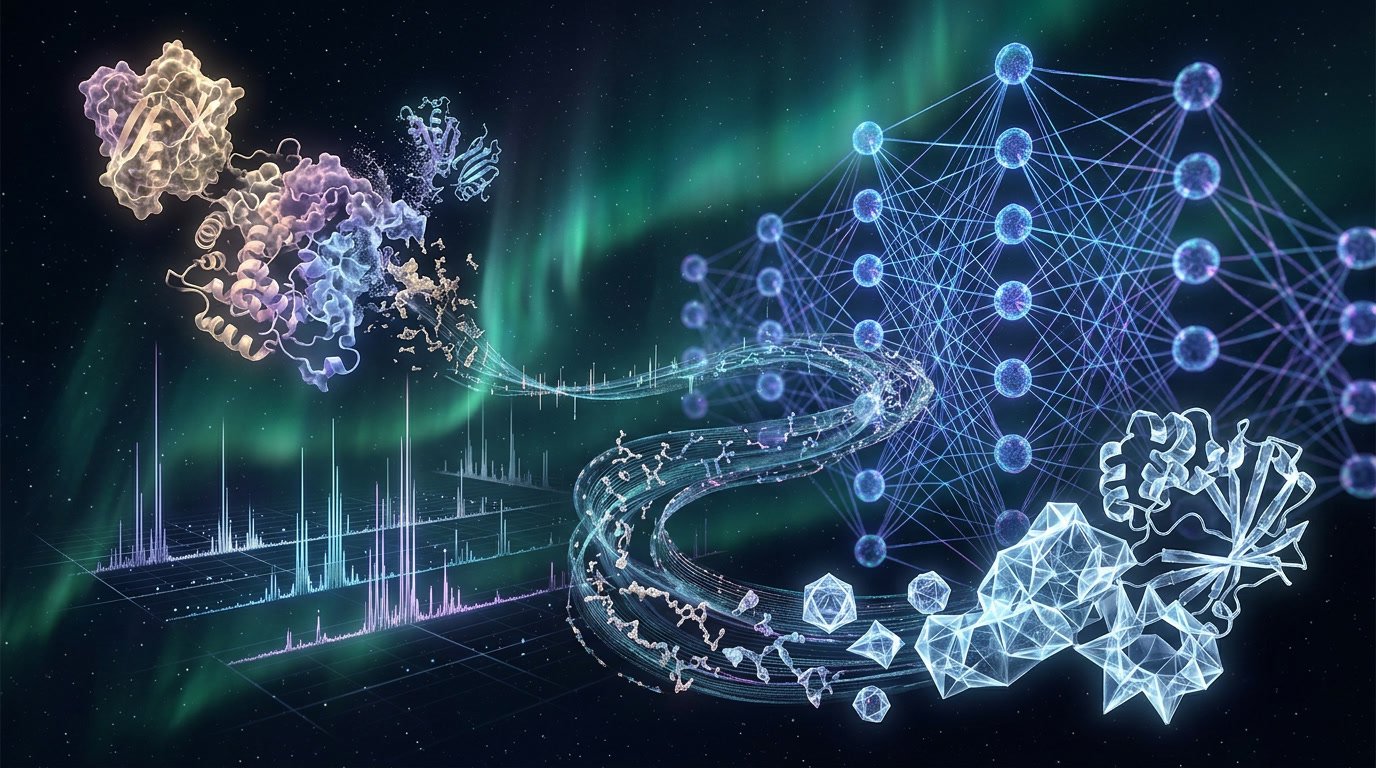
You know what’s not glamorous? Protein characterization.
Every biologics program, every antibody, every ADC, every bispecific, every gene therapy protein, has to go through it.
Structure.
Binding.
Function.
Post-translational modifications.
Aggregation.
Impurities.
The work is mostly mass spectrometry, and mass spec data is notoriously ugly. You’re working with massive files, analyzing weird peaks – most of it is manual interpretation and it requires weeks of PhD-level analysis per sample.
Most biologics companies have entire teams of analytical scientists doing this work. It’s expensive, it’s slow, and the results often sit in a spreadsheet that nobody else can actually read.
Enter 10x Science.
The San Francisco-based startup just closed a $4.8M oversubscribed seed round led by Initialized Capital, with Y Combinator, Civilization Ventures, Founder Factor, and strategic angels piling in.
The juice?
They’ve got an AI-native platform that eats mass spec (and other complex datasets) and outputs molecular-level insights on protein structure, binding, and function. Automated. Usable by biologists, not just by people with a degree in analytical chemistry.
10x Science · Seed round · April 2026
Seed
Initialized Capital (lead)
+ Y Combinator, Civilization Ventures, Founder Factor, angels
Here’s why this fits the current moment. Biologics are eating the pipeline. ADCs are everywhere. Bispecifics, trispecifics, tetraspecifics, degrader-antibody conjugates, peptide-drug conjugates – basically all the hot modalities require extensive protein characterization at every step.
And most of that work hasn’t been automated yet.
10X is promising infrastructure.
(Which is exactly what Y Combinator and Initialized like to fund.)
Initialized led Benchling‘s early rounds (the scientific data platform now worth billions), and they’ve been progressively deeper into bio tooling over the past few years. YC has backed a steady drumbeat of AI-bio tools over the past eighteen months.
ViewsML raised $4.9M last weekend to virtually stain pathology slides. GEn1E paid its manufacturer in equity because that’s how much AI-bio infrastructure is reshaping how small companies operate.
The Biotech Voyager
Early-stage biotech signals, personalized.
The signals that matter to you — contextualized and written directly to you — so you cut through the noise and immediately understand why it matters.
The reason mass spec specifically is a good AI target: it’s deterministic physics, it generates huge structured datasets, and the interpretation layer is the bottleneck. Modern transformer architectures are pretty good at this kind of pattern recognition.
It’s the same general setup that made AlphaFold work… take a well-defined physical problem, throw a lot of data at it, learn the patterns humans use to interpret it, then scale.
Proceeds are directed toward building infrastructure for biologics workflows, with cancer immunotherapy and gene therapy called out as specific application areas. Both involve complex protein characterization problems where faster and better analytical tools translate directly to faster development timelines.
$4.8M is a small round.
At seed stage, you’re probably not trying to build a full-scale company. You’re more likely trying to prove that the product solves a real problem for a handful of early customers, and that the unit economics work.
The pharma analytical services market is already north of $15B annually. If 10x can take a sliver of that — even just a small fraction for biologics characterization workflows — and do it faster and cheaper than a team of analytical chemists, this becomes a real business.
If they can make it good enough that biologists don’t need to hand off to analytical, it becomes a very big one.
For now, they’re a seed-stage YC company with a reasonable thesis and a lead that has a track record in the space. That’s worth watching.