Bispecifics were the exciting thing five years ago.
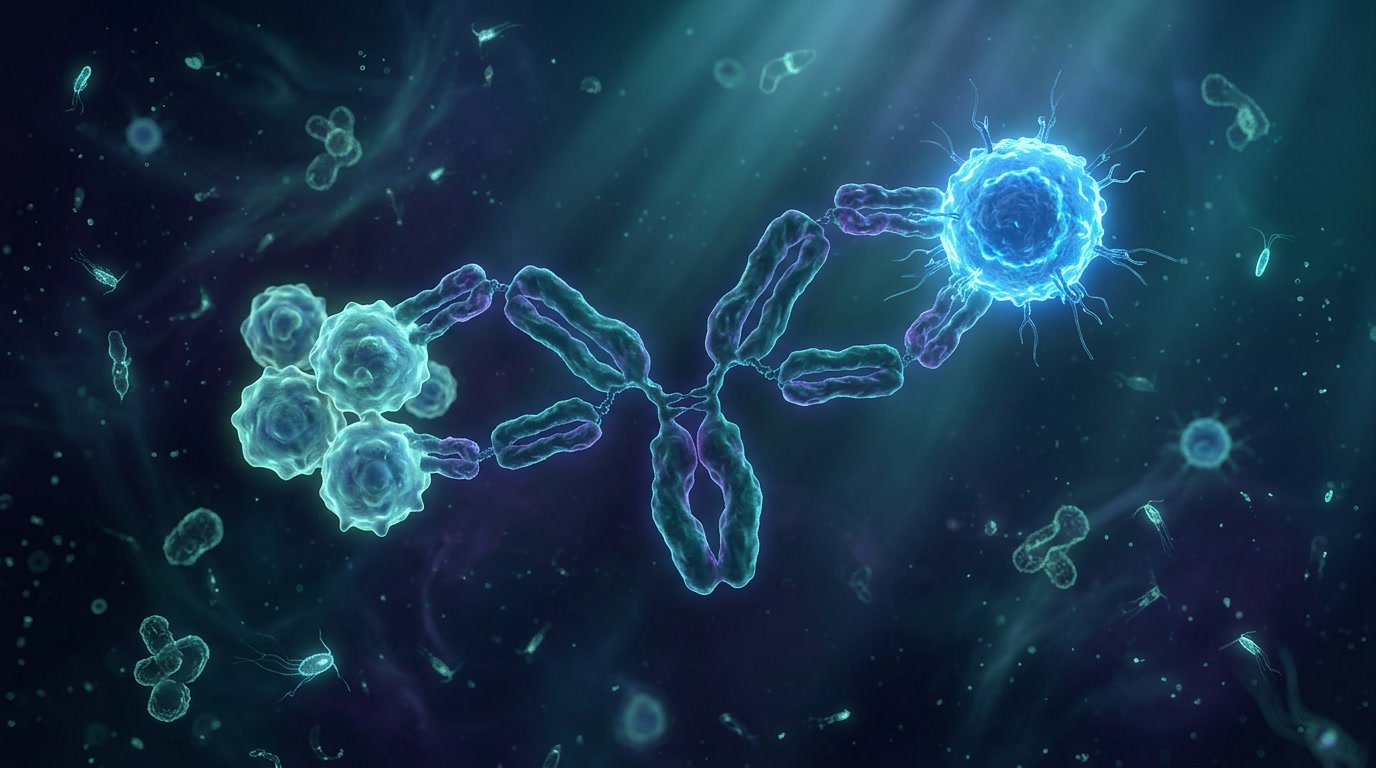
Then came trispecifics, and the field decided that two tumor antigens plus CD3 was better than one. Now ModeX Therapeutics, a subsidiary of OPKO Health, has dosed the first patient with MDX2003 — a tetraspecific T-cell engager. Four binding domains on one molecule.
CD19 and CD20 on the tumor. CD3 and CD28 on the T cell. All at once.
The company is calling it first-in-class. The trial is an open-label Phase 1 dose-escalation-and-expansion study in relapsed or refractory B-cell lymphoma.
The interesting question isn’t really whether a tetraspecific works. It’s whether anyone can afford to ignore the T-cell engager field anymore.
Because the money is moving.
Recent T-cell engager deals & milestones (2026)
March 2026
Gilead acquires Ouro Medicines for OM336 (gamgertamig), a BCMA×CD3 bispecific TCE in Phase 1/2 for autoimmune indications. Terms undisclosed.
March 2026
UCB licenses ATG-201 from Antengene — CD19/CD3 bispecific TCE for autoimmune. $80M upfront, >$1.1B in potential milestones plus royalties.
March 2026
Kali Therapeutics dosed first patient with KT501, a CD19×BCMA×CD3 trispecific TCE in rheumatoid arthritis.
April 2026
Mabwell filed the world’s first LILRB4/CD3 TCE IND with China’s NMPA.
April 2026
Janux now has three PSMA TCEs in/near the clinic, including a CD28 co-stim engager.
April 22, 2026
ModeX dosed MDX2003 — tetraspecific CD19/CD20/CD3/CD28 TCE in r/r B-cell lymphoma.
So in a single quarter: one full acquisition, one $1.1B+ licensing deal, two first-in-human dosings of novel specificity configurations, and multiple platform pipeline expansions. All in T-cell engagers.
What’s driving it? Two things.
First: CD19-targeted approaches are no longer just an oncology story.
B-cell autoimmune diseases like lupus, rheumatoid arthritis, myasthenia gravis, multiple sclerosis, increasingly look like they respond to B-cell depletion. Kyverna’s CAR-T held the MG response at 52 weeks.
The TCE version is a faster, off-the-shelf path to the same mechanism. That’s why Gilead bought Ouro. That’s why UCB paid $1.1B for an Antengene asset.
The Biotech Voyager
Early-stage biotech signals, personalized.
The signals that matter to you — contextualized and written directly to you — so you cut through the noise and immediately understand why it matters.
Second: monospecific and bispecific TCEs have a persistent problem. Tumors lose one antigen and escape. Adding a second tumor antigen — CD19 and CD20, the two most consistent markers on B-cell malignancies — raises the bar for escape. Lose one? No sweat. The drug still engages.
The CD28 co-stimulation piece is the other half.
Classic bispecifics only hit CD3. They activate T cells but don’t sustain them. Without co-stim, the T cells get exhausted quickly – in fact, CD3 signaling alone will cause angergy…super bad if you want T cell activity.
Adding a CD28 signal is the molecular equivalent of giving those T cells a second wind. It’s also what Janux is doing with their PSMA TRACIr platform, and what Deck Bio is doing with TCR-based bispecifics.
ModeX is kind of late to the B-cell TCE party. Roche’s glofitamab and Genmab/AbbVie’s epcoritamab are already approved in DLBCL. But they’re betting that dual-antigen + co-stim resolves the resistance and durability gaps of the approved bispecifics.
MDX2003 is preclinical-ish – first patient just dosed. No efficacy data for a while. But the real signal here isn’t just one company’s molecule. It’s that T-cell engagers have officially become the modality big pharma will pay billions to acquire, and the specificity arms race is still escalating.
Bispecific was yesterday. Trispecific is today. Tetraspecific just got its first patient.
Someone’s going to try five next. Watch.