So, oncology has a bit of a problem.
Every checkpoint inhibitor, every ADC, every bispecific engager, every CAR-T is fishing in the same small pond.
HER2. EGFR. CD19. BCMA. PD-1/L1. CLDN18.2. TROP2. Nectin-4.
You can probably list the majority of the targets off the top of your head. And the pharmaceutical industry has been fighting over this handful of targets for like 20 years.
This has happened for a few reasons – mainly, “it’s working”. But also, there just aren’t that many known, targetable, disease-relevant proteins out there.
But there’s something that, until recently, was simply…overlooked.
Only about 2% of the genome actually encodes for functional proteins. Meanwhile, the other 98% just kind “sits there”…or so we thought.
For decades, scientists called non-coding DNA “junk.”
Evolutionary leftovers. Nothing interesting.
It turns out that was wrong.
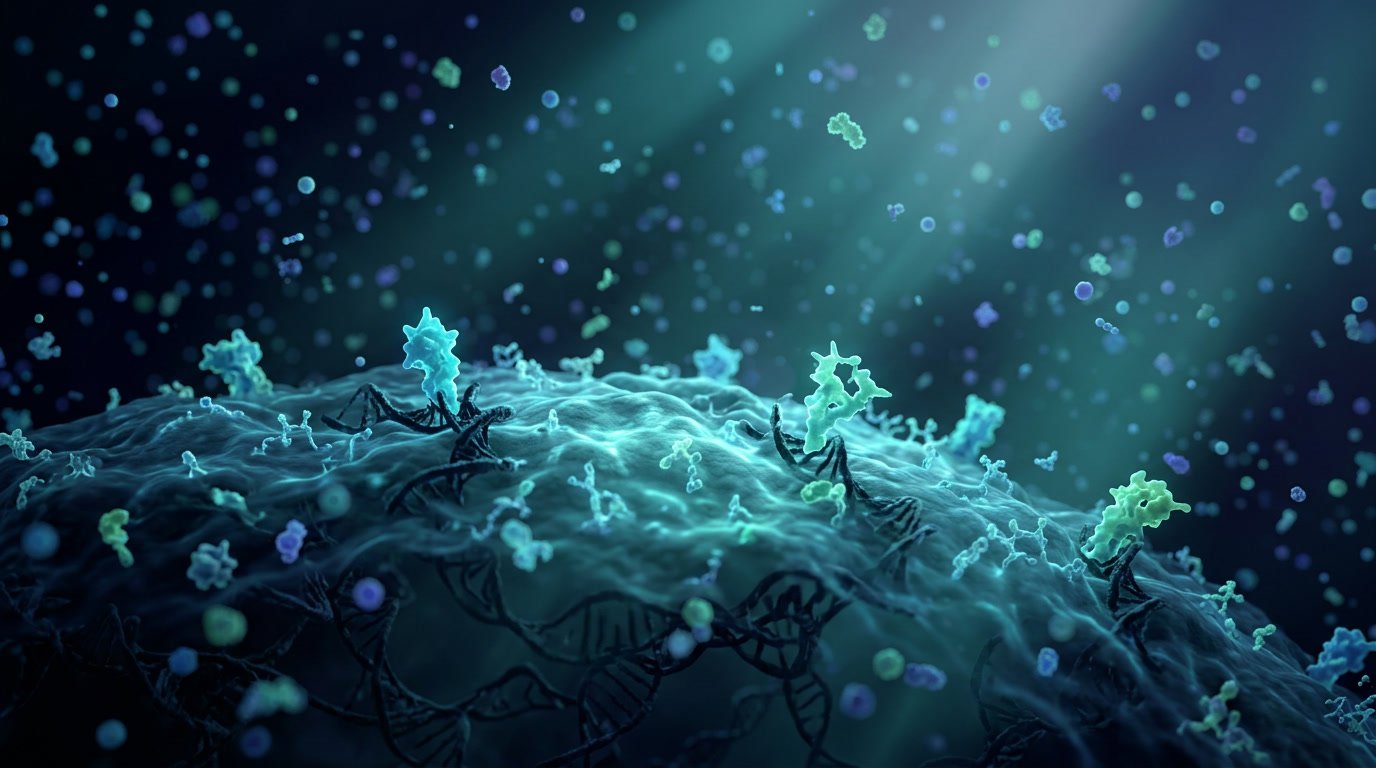
Cancer cells aberrantly transcribe and translate chunks of this so-called junk, producing proteins healthy cells don’t make, displaying peptides on their surface that are exclusive to tumors.
Researchers call it the dark proteome or the dark genome.
And if you go looking, there’s a whole quiet wave of companies going after it. Some from the RNA side. Some from the protein side. Some chasing cryptic cancer antigens. Others mining transposable elements and repeatomes that only get activated in disease states.
Here’s who’s in the mix right now.
The Dark Side of Biotech — company landscape
| Company | Stage | Approach |
|---|---|---|
| RyboDyn | Discovery | AI-driven RNA sequencing to find cryptic peptides exclusive to cancer cells, developing antibodies and ADCs |
| Enara Bio | Preclinical (IND-enabling) | Bispecific T cell engagers against dark-proteome antigens in solid tumors, lead asset ENA101 into clinic H2 2026 |
| Epitopea | Phase 1/1b (MHRA cleared) | Off-the-shelf RNA cancer vaccines targeting cryptic tumor antigens, Merck deal worth up to $300M per product |
| Velia Therapeutics | Discovery | Microprotein therapeutics from dark matter of the proteome, previously hidden class of human proteins |
| ROME Therapeutics | Clinical | LINE-1 reverse transcriptase inhibitors targeting the repeatome (60% of genome) for cancer and autoimmune |
| Transposon Therapeutics | Phase 2 | LINE-1 retrotransposon inhibitors for neurodegeneration and ARPA-H-funded healthy aging program |
| Soley Therapeutics | Preclinical | Modulators of intrinsically disordered proteins like CKAP2 that conventional methods can’t see or drug |
Stage reflects most advanced clinical program as of April 2026
Interested? Let’s dive into each of these.
—
RyboDyn kicked off the cancer conversation.
The San Diego company closed a $10 million seed on March 24, 2026, after spending 2025 proving out CypherAtlas, their platform built on a proprietary RNA sequencing technology called RyboCypher that catches RNAs conventional methods miss.
Their atlas now contains 80,000-plus cryptic peptides identified by mass spec, about 15,000 of them cancer-specific. One target they surfaced is present on 45% of HER2-negative breast cancer tumors, including triple-negative. Moffitt validated the targets independently.
Lilly pulled them into its AI TuneLabs consortium.
—
Then, Enara Bio came out of Oxford with ENA101, a bispecific T cell engager targeting DARKFOX-A3, a dark-proteome peptide-HLA complex.
AACR 2026 preclinical data showed low-picomolar potency and complete tumor regression in vivo. IND-enabling studies underway, clinical entry planned for H2 2026.
—
Epitopea just got MHRA clearance on April 23 for CryptiVax-1001, an off-the-shelf RNA cancer vaccine in advanced ovarian cancer. Their CryptoMap platform published in Nature Cancer showed that of 589 tumor antigens they identified, only 1% came from mutated sequences.
Roughly 37% were cryptic. Merck signed a deal worth up to $300 million per product.
The Biotech Voyager
Early-stage biotech signals, personalized.
The signals that matter to you — contextualized and written directly to you — so you cut through the noise and immediately understand why it matters.
Velia Therapeutics is in the same neighborhood but coming at it differently.
The San Diego company (founded 2021) built a discovery platform around microproteins, a newly recognized class of human proteins hiding in the dark proteome.
Their thesis: these small proteins, encoded by ORFs conventional annotation pipelines skip, play real roles in disease biology and offer a whole new therapeutic target class.
—
ROME Therapeutics goes after a specific subset of dark DNA — the repeatome.
About 60% of the human genome is repetitive sequences (LINE-1 elements, endogenous retroviruses, transposable elements), long dismissed as junk.
ROME developed LINE-1 reverse transcriptase inhibitors to shut down aberrant repeatome activity that is thought to drive autoimmune disease and cancer.
They reached clinical stage before winding down operations and getting scooped up by Pretzel back in January.
—
Transposon Therapeutics is a Phase 2 company working the same LINE-1 biology but for neurodegeneration, with an ARPA-H-funded program for up to $22 million exploring healthy aging.
Different disease area, same underlying science: the parts of the genome that are supposed to stay silent get reactivated in disease, and turning them off is a legitimate therapeutic strategy.
—
And then there’s Soley Therapeutics, which isn’t technically dark proteome but belongs in the conversation. They drugged CKAP2, an intrinsically disordered protein most of the industry had given up on.
Same philosophy: the targets conventional methods can’t see are where the opportunities are.
—
The dark proteome thesis still needs human validation.
But look at who’s paying attention.
Merck wrote a $300M-per-product check to Epitopea.
Lilly pulled RyboDyn into its AI TuneLabs consortium.
ROME generated enough real data to get acquired.
Transposon landed ARPA-H funding.
These aren’t really fringe bets anymore…it’s becoming a household name in the halls of big pharma.
I think this is mostly due to advances in genomic technology – we are now able to look in the dark corners of the room.
Watch Epitopea’s OVACT readouts first. That’s the canary in coalmine.
If cryptic antigens prove immunogenic and safe in humans, the whole dark proteome wave gets validated in one dataset. If they don’t, we find out whether this is a real biological frontier or another platform that worked in mice.