
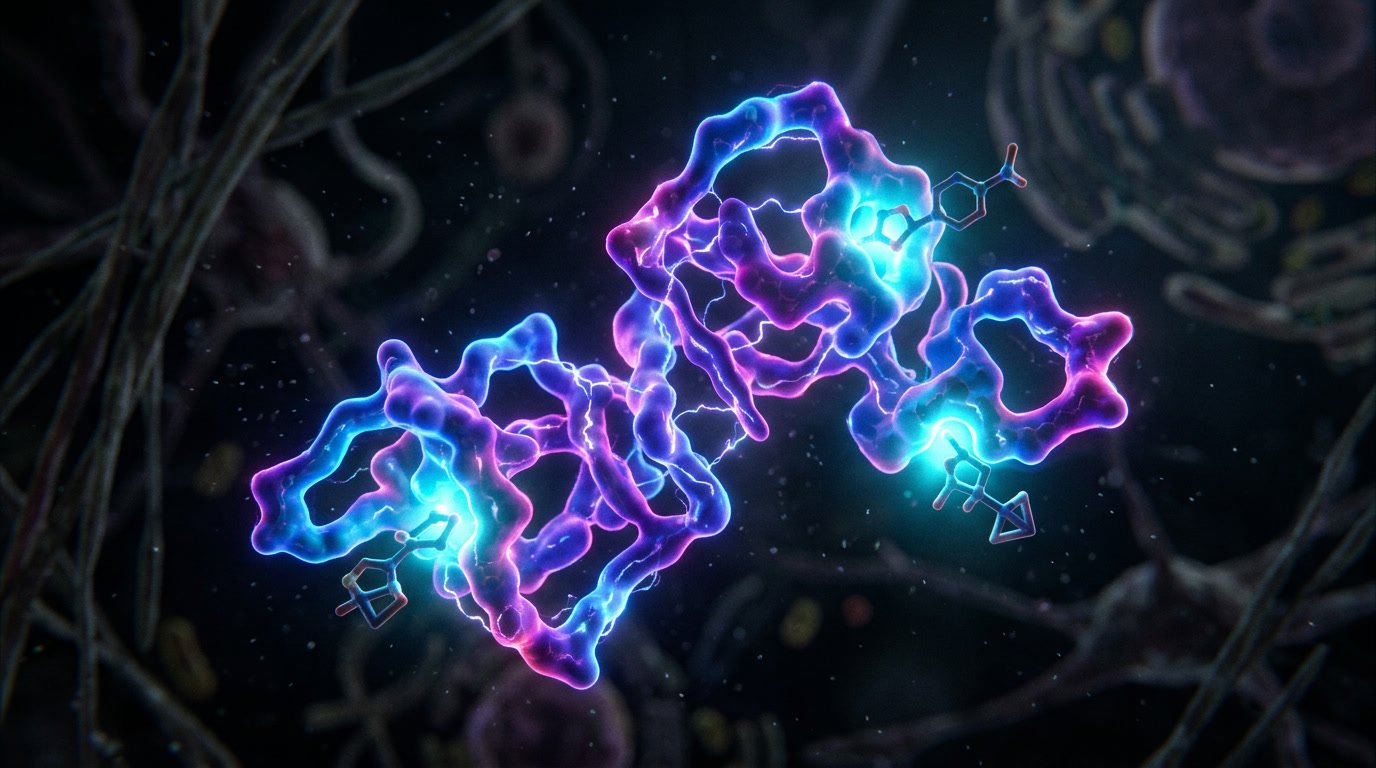
Here’s something weird about proteins.
Most of them fold into a specific 3D shape. That shape has pockets. Drug developers find those pockets and design small molecules that fit into them. Pretty much every oral drug on the market works this way.
Except a huge chunk of the human proteome doesn’t fold. These are called intrinsically disordered proteins, or IDPs. They wiggle around. They don’t have stable pockets. They’ve been considered essentially undruggable since people started classifying them in the 2000s.
Which is annoying, because a lot of IDPs are absolutely critical to cancer. Including one called CKAP2, which helps tumors proliferate, migrate, and build their own blood supply.
Soley Therapeutics presented preclinical data at AACR 2026 for STX-6398, an oral small molecule that modulates CKAP2.
Read that sentence again. An oral small molecule. Against an intrinsically disordered protein.
Soley was founded in 2018 by Kurosh Ameri and Yerem Yeghiazarians. The company’s approach doesn’t start with a target. It starts with cells. They built a platform that measures how living human cells respond to thousands of drug exposures, using computer vision and AI to decode what’s called cell stress biology.
The idea: don’t try to dock into a folded pocket. Find compounds that measurably change cell behavior, then work backward to figure out what they’re doing.
In January, Soley raised $200M in a Series C led by Surveyor Capital. That brought their total to $290M. They’ve got AI compute partnerships with Oracle and NVIDIA. A lead AML program heading toward an IND filing in 2026.
STX-6398 preclinical activity
300
Solid + heme
Activity correlated with CKAP2 expression. Supports biomarker-driven patient selection.
The STX-6398 data is what you’d want to see from a platform claim. Activity across 300 cell lines spanning both solid tumor and hematologic malignancy models. Activity that correlates with how much CKAP2 the tumor expresses, meaning you could potentially pick the right patients based on a biomarker.
Mechanistically, they’re seeing disruption of FAK pathway signaling, impaired cell migration, microtubule instability, cell cycle arrest, anti-angiogenic effects, and retained activity under hypoxic conditions.
That’s a lot of things. Which is what you’d expect when you modulate an IDP that sits at the center of multiple processes.
The AI-in-biotech framing here is worth noting. Most AI drug discovery stories are about generating better antibodies, engineering better molecular glues, or hitting targets nobody else can hit. What Soley is claiming is something different: they’re finding targets that nobody knew they could drug.
Two clinical programs are coming. An AML asset with IND filing planned for 2026. A solid tumor asset entering IND-enabling studies. STX-6398 sits further back in the pipeline, still preclinical, with no phase disclosed yet.
But if the platform delivers on the IDP promise, and the CKAP2 program is the first real test, Soley is going to be one of the more interesting early-stage AI drug discovery companies to watch.
The Biotech Voyager
Early-stage biotech signals, personalized.
The signals that matter to you. Contextualized and written directly to you. So you cut through the noise and immediately understand why it matters.