
Neuralink gets the magazine covers. Synchron gets the press releases. Precision Neuroscience gets the regulatory headlines.
Meanwhile, a Barcelona company nobody in the US was really watching finished enrolling the first human study of a brain-computer interface made out of graphene.
INBRAIN Neuroelectronics announced this week that its first-in-human study of BCI-Tx, a graphene-based cortical interface, is fully enrolled. The trial ran at Salford Royal Hospital in Manchester, in patients undergoing brain tumor surgery. The headline findings: no device-related adverse events, no device failures, and successful capture of high-resolution neural signals.
Patient numbers, trial phase, and primary endpoint data weren’t disclosed. That’s normal for a study this early. What matters is this: graphene, as a clinical-grade material for direct brain contact, now has human data behind it.
How INBRAIN stacks up against other BCI programs
First-in-human enrolled
Human (PRIME)
Human (COMMAND)
Human (intraop)
Four serious BCI bets, four different materials and form factors.
The Biotech Voyager
Early-stage biotech signals, personalized.
The signals that matter to you, contextualized and written directly to you, so you cut through the noise and immediately understand why it matters.
Why graphene?
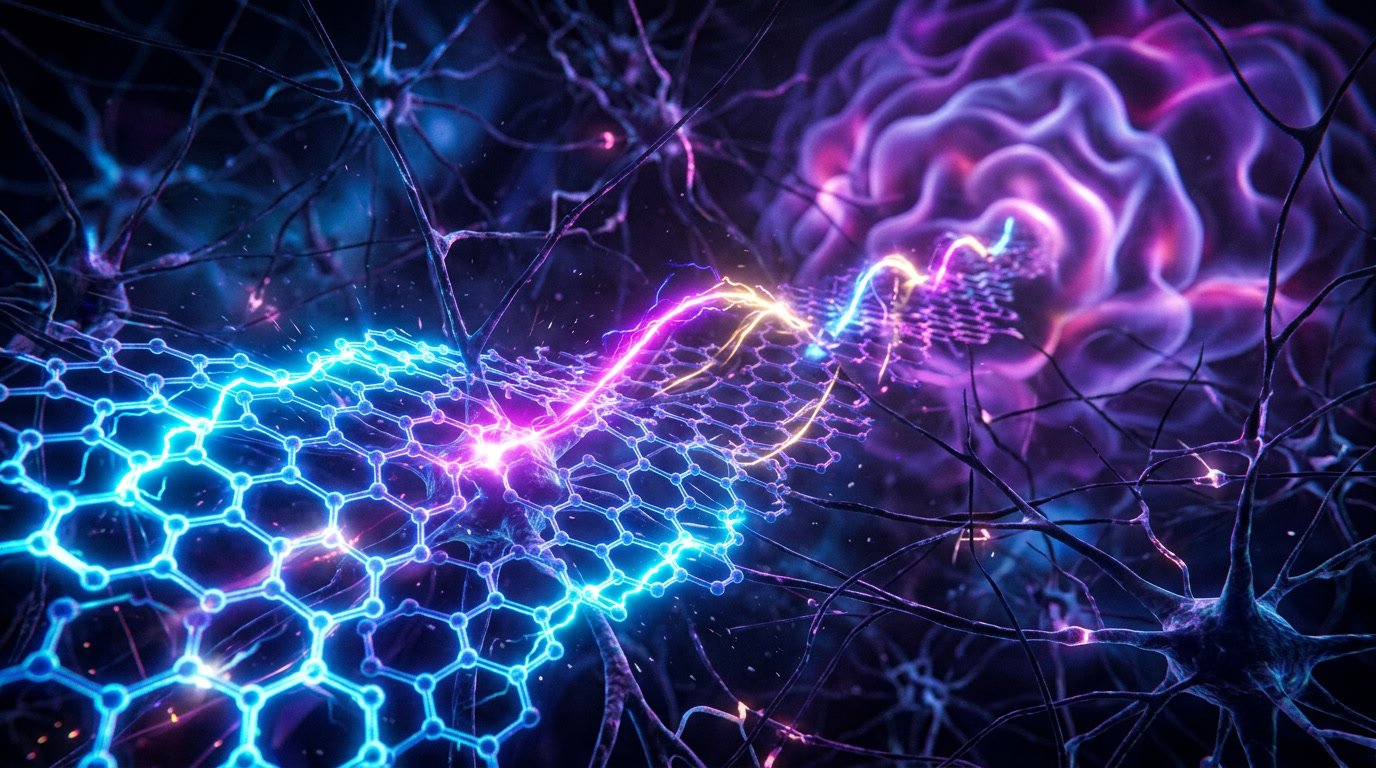
Silicon microelectrodes scar. Metal electrodes are large and have resolution limits. Graphene is essentially a single atomic layer of carbon, which means the interface conforms to brain tissue, doesn’t corrode, and can pack up to 1,024 contacts into very small real estate.
INBRAIN pairs that hardware with real-time decoding and adaptive stimulation, closed-loop. The therapeutic targets are Parkinson’s, epilepsy, stroke rehab, and psychiatric disorders. Through its spinoff INNERVIA Bioelectronics, built with Merck KGaA, the platform is also going after peripheral nerve and systemic diseases.
The company has raised $68M to date, including a $50M Series B last October led by imec.xpand. It also has FDA Breakthrough Device designation for Parkinson’s and is in the FDA’s TAP program, which is essentially a monthly FDA phone call to speed development.
First-in-human BCI data from a non-US player is not nothing. And this one has a Nobel Laureate, Kostya Novoselov, who discovered stable graphene in 2004, on its scientific advisory board. Worth watching the full data release when it comes.